September 17, 2026
Drywall joints crack after installation when stress develops at a finished seam and exceeds what the tape and joint compound can tolerate. Common causes include movement in the framing, weak joint finishing, inadequate board attachment, and changing environmental conditions. The crack pattern, whether it changes over time, and what is happening around it help determine whether the problem is cosmetic, installation-related, or connected to movement elsewhere in the building. Truerock Interior Systems works with drywall assemblies in Edmonton where identifying the cause matters before deciding how the joint should be repaired.
The location, direction, width, and behaviour of a crack provide useful clues about what is happening at the joint. A narrow crack that remains unchanged is different from one that repeatedly returns, becomes wider, or develops visible separation between adjoining drywall surfaces. A drywall crack by itself does not establish that structural damage is present. The first step is determining whether the crack appears limited to the finished joint or shows evidence of continued movement.
A thin crack that follows a drywall seam is commonly associated with minor movement or failure within the finished joint. If it remains narrow and stable with no displacement of the surrounding drywall, the problem may be limited to the tape or joint compound. A crack that returns after the joint has been properly retaped and refinished points to an unresolved source of movement or an attachment problem. Reapplying compounds over the visible line without addressing that source is unlikely to produce a durable repair.
Cracks at inside corners or wall-to-ceiling intersections often occur where adjoining assemblies respond differently to movement. Walls, ceilings, roof framing, and floor framing do not necessarily move together, which can concentrate stress at their intersections. A ceiling-line crack should therefore be assessed as part of the surrounding assembly rather than treated automatically as a failed layer of compound. Movement in the framing, attachment of the drywall, and the condition of the surrounding drywall ceiling all affect the appropriate repair.
Recurring or widening cracks require more investigation than a stable hairline joint crack because the drywall is continuing to experience stress. The visible joint should not be repeatedly refinished until the reason for that movement is understood. A crack that continues to open, changes noticeably over time, or returns after a complete joint repair indicates that the cause is not limited to the visible surface finish. That pattern makes identifying the source of movement more important than another cosmetic repair.
Drywall joint cracking usually develops because the supporting assembly moves, the finished joint is weak, or the drywall is not adequately supported. Environmental conditions can also contribute by affecting framing materials or the conditions under which joint compound dries. Determining which factor is responsible matters because refinishing the seam will not correct loose board, ongoing framing movement, or another underlying defect. The repair approach should therefore match the actual cause rather than the appearance of the crack alone.
Drywall is attached to framing that undergoes small dimensional changes and deflection as building conditions change. Wood framing may shrink as its moisture content changes, while roof, floor, and wall framing may move under loads or seasonal conditions. When adjoining materials move by different amounts, stress can concentrate at drywall seams, corners, openings, and intersections. This does not mean every joint crack indicates a structural defect, because the more important distinction is whether the movement has stabilized or is continuing to affect the finished assembly.
A finished joint relies on proper tape embedment, suitable joint compound application, and sufficient drying between coats. Poor tape adhesion, inadequate compound beneath the tape, excessive buildup, contaminated surfaces, or applying another coat before the previous layer has dried sufficiently can weaken the joint.
Rapid drying conditions or excessive airflow can also contribute to cracking, checking, or poor bond at the joint. Excess water in drying-type compounds may increase shrinkage as the material dries. Professional drywall taping and texture work therefore depends on both correct application and suitable jobsite conditions. When the failure is limited to the tape or compound and the board remains securely attached, the repair can usually remain focused on the affected joint.
Drywall joints are more likely to crack when panels are able to move independently of their supporting framing. This can happen where board edges lack appropriate support, fasteners miss framing, fastening is insufficient, or the drywall is otherwise loose.
Fasteners that damage the face paper around the screw head can also reduce the strength of the attachment at that location. Depending on the assembly, attachment problems may appear as joint cracks, fastener pops, or movement when pressure is applied to the panel. The drywall must be secured before the failed joint is refinished. Repairing the surface while the board continues moving leaves the original cause in place.
Edmonton buildings may experience large seasonal differences in outdoor temperature and changes in indoor humidity, particularly between heated winter conditions and warmer seasons. How much those changes affect the drywall assembly depends on the framing type, building envelope, HVAC operation, and indoor moisture conditions.
Changes in moisture content can cause wood framing to shrink or expand, while temperature changes affect the dimensional behaviour of other building materials. Where those movements transfer stress into a drywall joint, a crack may become more visible during particular seasons. A recurring seasonal pattern identifies when movement is occurring, but it does not establish whether that movement is normal or whether the framing, attachment, or joint detailing needs correction. The underlying assembly still needs to be assessed before repeated repairs are made.
Drywall cracking warrants broader investigation when the pattern suggests that the joint is reacting to movement, moisture, or deterioration elsewhere in the building. In these cases, repairing the drywall before identifying the underlying condition risks another failure. The more the cracking is accompanied by changes in adjacent building components, the less useful a surface-only repair becomes. Diagnosis should therefore focus on whether the drywall is the source of the problem or simply where another problem is becoming visible.
Cracking deserves additional assessment when several symptoms develop together, such as widening diagonal cracks, multiple cracks around openings, visible separation between connected surfaces, displaced drywall, or changes in the operation of nearby doors and windows. Cracks around doors and windows do not automatically indicate foundation movement because joint placement, board attachment, framing movement, and the construction around the opening can also contribute.
Foundation movement, framing shrinkage, deflection, and movement between structural components can produce overlapping symptoms. The drywall crack alone cannot establish which condition is responsible. If cracking is continuing or appears alongside broader building movement, the underlying structure should be evaluated by an appropriate qualified professional before the drywall is cosmetically repaired. This avoids treating a visible symptom while the source of movement remains active.
Moisture can damage drywall facing, reduce the integrity of joint finishes, and affect wood framing. Staining, softened drywall, bubbling finishes, persistent dampness, or deterioration near a crack are reasons to investigate for a moisture source rather than treating the area as an ordinary joint failure.
In some wall or ceiling assemblies, insulation gaps or problems with air and vapour control can contribute to cold surfaces and condensation. Whether this occurs depends on the assembly design and site conditions, so the cause should be confirmed rather than assumed from the crack alone. Active leaks, condensation, or damp materials should be addressed before damaged drywall is refinished or replaced. Finishing over an unresolved moisture source increases the likelihood that the damage will return.
The repair scope depends on whether the failure is confined to the finished joint or involves the drywall board, its attachment, moisture damage, or continuing movement. A visible crack does not automatically require removing and reinstalling the surrounding drywall. Localized defects are usually treated differently from failures involving damaged or unstable board. The table below compares common crack patterns with the level of repair they may require.
| Crack Type | Likely Cause | Recommended Fix | Severity |
| Stable hairline crack along one seam | Possible localized joint movement or finishing failure | Open the failed area as needed, retape where required, and refinish | Low if stable |
| Loose or separated joint tape | Possible adhesion or finishing failure | Remove loose material, retape, and refinish the joint | Low to moderate |
| Crack with loose drywall | Board attachment or support problem | Correct the attachment before repairing the joint | Moderate |
| Crack that returns seasonally | Repeated assembly or framing movement | Determine the movement source before choosing the repair detail | Moderate |
| Multiple widening or recurring cracks | Possible continuing building movement | Investigate the underlying movement before drywall repair | Moderate to high |
| Crack with staining or softened drywall | Possible moisture exposure | Correct the moisture source and assess damaged material before refinishing | Moderate to high |
| Displaced or deteriorated drywall | Board damage or unresolved underlying failure | Replace affected drywall after the cause has been corrected | High |
Localized finishing failures normally require repair to the affected joint rather than removal of an entire wall or ceiling. Partial drywall replacement becomes more appropriate when the board itself is damaged, deteriorated, inadequately supported, or unable to remain stable after the underlying problem is corrected.
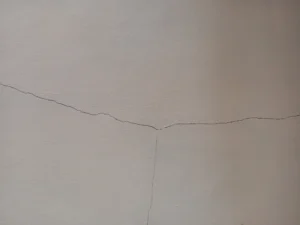
Crack prevention begins with a stable substrate and proper board attachment. Framing should be aligned for the intended drywall assembly, panel edges must receive the support required by the installation, and fasteners must secure the board without unnecessarily damaging its face paper.
Panel layout also matters around door and window openings. Joint placement should follow the requirements of the selected drywall system and applicable installation guidance so joints are not unnecessarily positioned where movement and stress are concentrated. Finishing conditions also matter because joint compound should be applied under suitable temperature, humidity, and ventilation conditions. Each coat should be allowed to dry as required before subsequent finishing proceeds.
Assemblies also need to account for expected movement. Control joints or other movement details should be installed where required by the project design, drywall system, or applicable installation requirements rather than added only after cracking develops. Taping and finishing cannot correct unstable framing, loose drywall, or active moisture problems. Those conditions need to be resolved before the finished joints are expected to remain stable.
A drywall contractor should assess cracking when the joint repeatedly fails, the drywall is loose or damaged, several cracks are appearing in the same area, ceiling or corner joints continue separating, or the required repair is unclear. The contractor can assess whether the visible problem is confined to the drywall system or whether another issue should be investigated first.
If the crack pattern indicates possible foundation movement, structural movement, active moisture intrusion, or another condition outside the drywall system, that issue should be evaluated by the appropriate trade or building professional before finishing work proceeds. For drywall joint problems in Edmonton residential and commercial interiors, Truerock Interior Systems can assess the affected drywall and determine the appropriate repair scope before refinishing.
