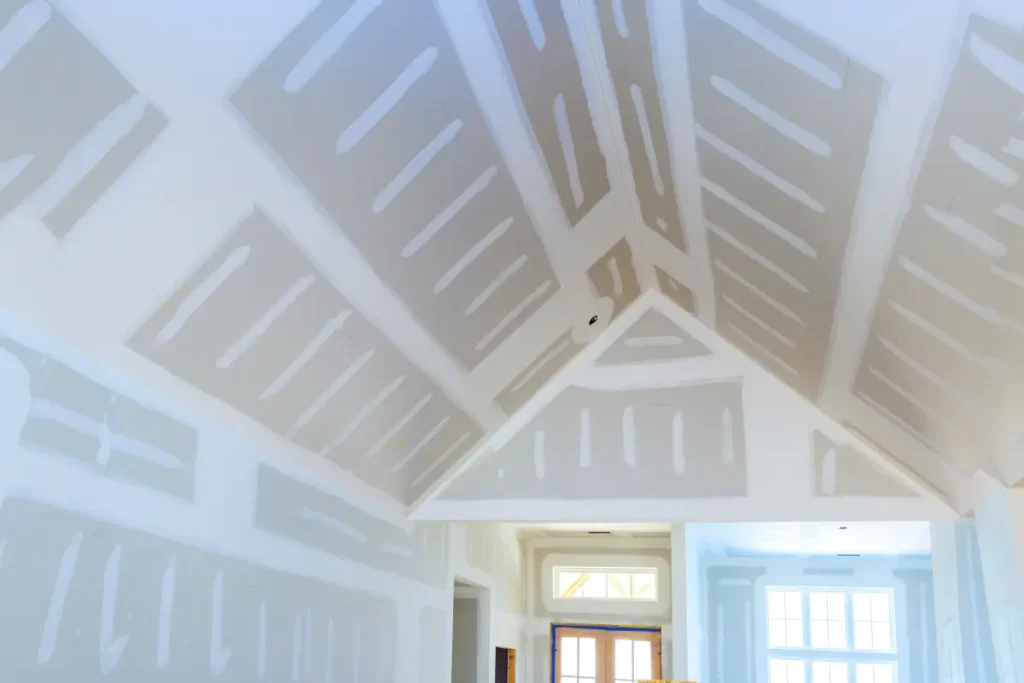
Drywall that has been installed but not finished cannot be painted or textured without visible seams, fasteners, and surface inconsistencies, which is why Truerock Interior provides taping, mudding, and texture work that brings surfaces to a consistent, paint-ready finish based on defined finish levels, lighting exposure, and paint type.

587-989-3517
This stage determines how uniform the surface appears after paint and how well joints hold over time under normal building movement.
All joints are reinforced with tape and built up with compound to eliminate visible transitions between boards, while wider gaps, misaligned seams, or previously failed joints require additional layers to prevent cracking and separation after finishing.
Each coat is sanded to control flatness and remove buildup between layers, since surface quality at this stage directly affects how paint reflects light and exposes imperfections, with higher finish levels requiring tighter sanding tolerances and more controlled passes.
Finish level defines how much surface variation remains visible after painting, where Level 4 suits standard residential applications with limited light exposure, while Level 5 includes a full skim coat across the surface to reduce visibility under direct lighting and higher sheen paints.
Texture selection affects both the final appearance and the level of preparation required before finishing.
Smooth finishes rely on compound uniformity with no surface variation to hide defects, which makes Level 5 necessary across large flat walls, ceilings, and areas exposed to window light where even minor inconsistencies become visible.
Spray-applied textures introduce controlled variation that reduces the visibility of minor surface inconsistencies, which reduces the need for full skim coating and is commonly used on ceilings or areas where a uniform textured appearance is preferred.
Existing textures are replicated by adjusting spray pattern, compound thickness, and application method, although blending works best within contained repair areas while larger surfaces often require full reapplication to avoid visible transitions.
587-989-3517
Taping and finishing is required whenever drywall surfaces are incomplete, altered, or visually inconsistent.
Installed drywall remains unfinished until joints, fasteners, and corners are covered and built up with compound, making this stage mandatory before any paint or texture can be applied.
Defects such as visible seams, uneven compound, or poor sanding become more pronounced after painting, which requires additional mudding, sanding, or full skim coating depending on the severity of the issue.
Work follows a defined sequence to control surface quality and prevent failure after completion.
Board alignment, fastening, and joint spacing are reviewed before finishing begins, especially in areas where insulation or framing work was recently completed, and any movement, gaps, or installation issues are corrected prior to applying compound to avoid future defects.
Compounds are applied in multiple coats to build a consistent surface across joints and fasteners, with drying time between coats required to prevent shrinkage and cracking, especially in Edmonton where colder conditions and limited airflow can extend drying timelines.
Final sanding establishes the required finish level and prepares the surface for paint or texture, while lighting is used during inspection to identify ridges, shadows, and inconsistencies before completion.
Work is defined by finish level, number of coats, and drying conditions before starting, which sets clear expectations for both outcome and timeline while reducing rework.
Scheduling is based on proper drying cycles rather than fixed timelines, since skipping drying stages leads to cracking, shrinkage, and surface failure, with key constraints addressed upfront including required drying time, full skim coating for Level 5 finishes, and environmental factors such as humidity and temperature.
Work is completed across Edmonton and surrounding areas including Sherwood Park, St. Albert, Spruce Grove, Beaumont, Leduc, and Stony Plain, with scheduling adjusted based on project size and site conditions.
Project scope is defined by Truerock Interior based on finish level, surface condition, and required corrections, with next steps including confirming finish level based on lighting and paint selection, identifying areas requiring taping or texture matching, and scheduling an on-site assessment.
587-989-3517
